


Ever wondered how different software applications talk to each other? The secret sauce often lies in REST APIs. Understanding REST APIs is not just a tech requirement but a business imperative.
In this guide, we’ll explore what a REST API is, how they work, and why they’re a game-changer for your business.
What is REST?
REST (Representational State Transfer) is an architectural style for designing networked APIs that exchange representations of resources over HTTP, defined by Roy Fielding in his 2000 dissertation. A REST API is any API that follows the REST constraints: client-server separation, statelessness, cacheability, uniform interface, layered system, and (optionally) code on demand. Most modern web and mobile APIs are RESTful precisely because these constraints make them simple to scale, debug, and consume from any client.
REST, or REpresentational State Transfer, is more than just an acronym; it’s the backbone of modern web and mobile applications. Created by Roy Fielding in 2000, REST is an architectural style that standardizes how applications communicate over the Internet.
By using stateless protocols and standard operations, REST simplifies the complexities of these interactions, making your systems more reliable and scalable.
The nuts and bolts: how do APIs function?
APIs, or Application Programming Interfaces, are the unsung heroes of our connected world. They act as the middlemen, allowing different software systems to talk to each other.
REST APIs take this a step further by adding a set of constraints and rules, making the communication more efficient and secure. Whether you’re booking a flight, sending an email, or even liking a post on social media, there’s an API working behind the scenes to make it all happen.
How do REST APIs work?
A REST API works by mapping URLs to resources and HTTP methods to actions on those resources. A client sends a request (for example GET /api/users/42), the server processes it without keeping any session state in memory, and returns a self-describing response (typically JSON) that includes both the data and the next available actions. Because every request carries everything the server needs to handle it, REST APIs scale horizontally by adding more servers behind a load balancer, with no session affinity required.
REST APIs function by breaking down a complex operation into smaller, manageable tasks. Each task is a specific API call, handled independently by the server.
For example, when you’re ordering food through an app, multiple REST API calls go out: one to check the menu, another to place the order, and yet another to update your delivery status.
This modular approach makes REST APIs incredibly flexible and well-suited for scalable cloud applications.
HTTP methods in a REST API
Every REST API call is a combination of an HTTP method and a resource URL. The method tells the server what to do with the resource. Six methods cover virtually every API operation, and choosing the right one is the difference between a REST API that scales and one that quietly breaks under load.
| Method | Purpose | Idempotent | Example |
|---|---|---|---|
| GET | Retrieve a resource without changing it | Yes | GET /api/orders/4521 |
| POST | Create a new resource on the server | No | POST /api/orders |
| PUT | Replace a resource entirely with the request payload | Yes | PUT /api/orders/4521 |
| PATCH | Update part of a resource without replacing the rest | No (by default) | PATCH /api/orders/4521 |
| DELETE | Remove a resource from the server | Yes | DELETE /api/orders/4521 |
| HEAD | Retrieve only response headers (no body), useful for existence checks | Yes | HEAD /api/orders/4521 |
Idempotency matters because intermittent network conditions cause client retries. An idempotent method is safe to retry (running it twice produces the same end state as running it once), while a non-idempotent method like POST can create duplicate resources if the client retries blindly. A well-designed REST API uses POST sparingly and PUT or PATCH (with explicit idempotency keys for POST) for everything else.
What makes an API RESTful?
An API is RESTful when it adheres to all six REST constraints, not just some of them. Many APIs that call themselves REST APIs are actually RPC-over-HTTP because they ignore the statelessness or uniform-interface rule. A strict RESTful API uses standard HTTP methods consistently, exposes resources at predictable URLs, returns hypermedia links so clients can discover related actions (HATEOAS), and never relies on server-side session state between requests. The closer your API gets to all six constraints, the easier it is to cache, version, and replace components without breaking clients.
To be considered RESTful, an API must adhere to six key architectural constraints:
- Uniform interface: This simplifies the architecture by using a consistent set of rules and conventions.
- Client-server architecture: This decouples the client from the server, allowing both to evolve independently.
- Stateless interactions: Each request from the client contains all the information needed to process the request.
- Cacheability: Responses must be explicitly marked as cacheable or non-cacheable to improve performance.
- Layered system: This allows for an architecture composed of hierarchical layers, adding more flexibility and scalability.
- Code on demand (optional): This allows the server to extend the client’s functionality by sending code to be executed.
Real-world examples of REST APIs
Stripe, Google, and Slack all have something in common? They all offer reliable, well-documented REST APIs that developers love.
Stripe’s API, for instance, handles billions of dollars every year, offering features like payment processing, subscription billing, and secure data storage. These APIs are the building blocks that enable businesses to offer rich, polished experiences to their users.
The many uses of REST APIs
From cloud computing to microservices, REST APIs are everywhere. Their stateless nature makes them ideal for distributed systems where reliability, scalability, and performance are critical.
Whether you’re building a multi-cloud solution or a simple web app, REST APIs offer the flexibility and ease of use you need to succeed in today’s fast-paced digital landscape.
The benefits of using REST APIs
REST APIs offer a plethora of benefits that go beyond just technical advantages:
- Simplified communication: A uniform interface makes it easier for different services to communicate.
- Flexibility: REST APIs can handle multiple types of calls, return different data formats and even change structurally with the correct implementation of hypermedia.
- Scalability: The stateless nature of REST APIs means that it’s easier to add more servers as your user base grows, ensuring that your architecture can scale with your business needs.
REST API vs. API
The difference between REST API and API is that API is the umbrella term for any contract between two software components, while REST API specifically means an API that follows the REST architectural style. SOAP APIs, GraphQL APIs, gRPC APIs, and event-streaming APIs are all APIs but none are REST APIs. When someone says they are building an API in 2026 they almost always mean a REST API by default, but the broader API category includes every other style as well.
While all REST APIs are APIs, not all APIs are RESTful. Traditional APIs often rely on complex standards and middleware, whereas REST APIs use standard HTTP methods and a much simpler architecture.
This makes REST APIs easier to implement, easier to scale, and easier to use, providing a more agile and efficient way to build applications.
Why REST APIs are important
In the interconnected world of today, REST APIs serve as the foundation of the digital ecosystem. They enable real-time data sharing and connectivity, driving the growth of web services and Internet of Things (IoT) applications.
Simply put, REST APIs are the linchpin of modern digital transformation strategies.
Before REST APIs: a brief history
Before the advent of REST APIs, the world relied on SOAP (Simple Object Access Protocol) for web services. While SOAP had its merits, it was often seen as overly complex and rigid.
The introduction of REST APIs revolutionized how we think about web services, offering a much-needed alternative that was flexible, lightweight, and easy to use.
REST vs SOAP vs GraphQL when to use each
REST is the dominant API style on the public internet, but it is not the only one. SOAP still runs in regulated industries and inside enterprise integration backbones; GraphQL has carved out a niche for client-driven data fetching. Picking the wrong style adds friction your API consumers will feel for years.
| Style | Best for | Trade-offs |
|---|---|---|
| REST | Resource-oriented public APIs, mobile and web clients, microservices, anything that benefits from HTTP caching | Multiple round-trips for related data; over-fetching when clients need only a subset of fields |
| SOAP | Strict contracts, banking, healthcare, government, anything that requires WS-Security, WS-ReliableMessaging, or formal WSDL contracts | Verbose XML envelopes, heavier on the wire and on developers, less browser-friendly |
| GraphQL | Client-driven data fetching across many related entities, BFF (Backend-for-Frontend) patterns, mobile apps optimizing payload size | Harder to cache, requires schema discipline, query complexity attacks need explicit guarding |
Most enterprises end up running all three side by side, which is why a federated API management platform like Amplify Fusion matters: it discovers, secures, and governs REST, SOAP, GraphQL, and event-streaming APIs from a single control plane, so the choice of style stays a design decision instead of a governance liability.
REST vs. SOAP
REST and SOAP serve the same purpose but in different ways. While REST uses standard HTTP protocols and is more lightweight, SOAP relies on XML-based messaging and offers built-in security features.
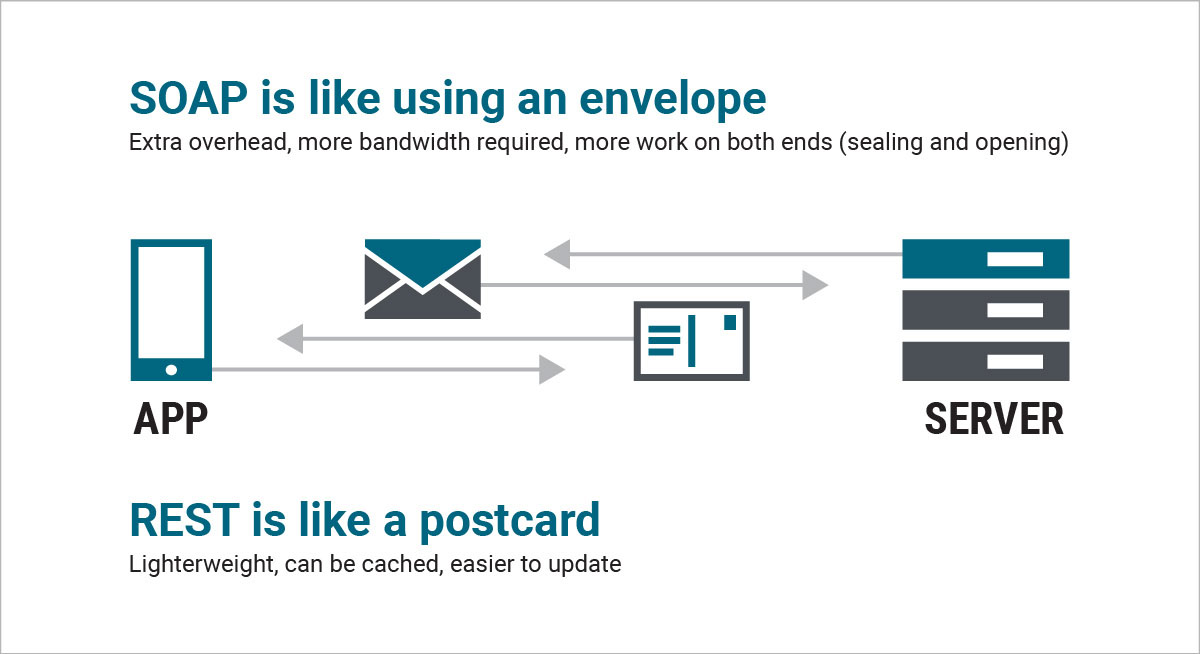
Each has its own set of pros and cons, but REST APIs generally offer more flexibility and are easier to work with, making them the preferred choice for many businesses.
How REST APIs can help your business
REST APIs are not just a developer’s tool; they’re a business enabler. By offering a simplified, standardized way to share data and services, REST APIs can help you break down silos, improve collaboration, and drive business innovation.
As the digital landscape continues to evolve, effective API management becomes increasingly critical, making it essential to understand and adopt REST APIs for your business success.
Whether your enterprise uses SOAP APIs, REST APIs, or more (such as events or GraphQL), Axway’s Amplify Platform can help bring visibility to all your APIs in a multi-cloud, multi-team, and multi-gateway environment.
Reduce API complexity and grow API adoption with an API platform that’s open, secure, and revolutionary.
Ready to take your API strategy to the next level? Discover how Axway’s Amplify Platform can help you manage, secure, and scale your APIs.