



Over the decades, B2B integration has quietly become one of the most mission-critical capabilities inside large enterprises. When it works, business flows smoothly across suppliers, customers, and partners. When it fails, revenue, compliance, and trust can break instantly. Even a few minutes of downtime can have serious consequences.
Recently, one automotive customer asked me to estimate the cost of B2B/EDI downtime. The numbers were eye-opening. Industry benchmarks show that critical IT or operational outages typically cost €250k to €500k per hour, and in automotive manufacturing, the impact can easily exceed €1–€2 million per hour. As the backbone of order-to-cash and supply chain processes, B2B integration plays a direct role in keeping production lines moving and partners synchronized. Manual work can only partially compensate for a disruption, and reputational damage or lost customer trust can cost far more than the outage itself.
In 2026, B2B integration leaders face a new reality. Partner ecosystems are expanding, AI innovations are reshaping how systems interact, whereas regulations continue to tighten. Hybrid cloud environments are becoming more complex, while cyber threats grow more sophisticated. At the same time, businesses expect IT teams to move faster, support new digital initiatives, and reduce operational costs.
This is the story of Gabe, a B2B integration leader responsible for keeping this critical layer running. You may recognize many of the challenges in his day-to-day work, but this story focuses on something different: what Gabe’s ideal day could look like when B2B integration evolves from a fragile operational necessity into a strategic business capability.
Gabe’s reality today
Today, Gabe manages B2B integration in a large enterprise where the ecosystem appears stable on the surface. Orders move, invoices are exchanged, and partners stay connected. But Gabe knows that a fragile foundation lies behind this stability.
Much of his team’s time goes into maintaining legacy EDI systems, manually onboarding partners, and monitoring integrations across several disconnected tools. Instead of focusing on innovation, the team often feels stuck in maintenance mode, constantly making sure nothing breaks. Some legacy mappings are understood by only a few senior engineers, which makes every change risky. And since these experts could retire at any moment, years of knowledge could disappear with them, making even small updates stressful for the team.
The ecosystem still works, but it moves too slowly for the pace of modern business. Instead of enabling growth, the integration layer increasingly becomes a bottleneck, while the business continues asking for faster expansion and lower costs. Gabe knows the current model cannot support the future.
Market pressure is rising
You’ve probably seen new LLMs throwing around buzzwords like “ever-changing,” and in most cases, it feels empty. But in Gabe’s context, it really fits. In an ever-changing, constantly disruptive environment, whether driven by IT, business demands, or geopolitical shifts, teams must manage growing ecosystems, rising security risks, and tighter compliance requirements, all while ensuring integrations run reliably across regions. Cloud platforms, APIs, and AI are transforming how systems connect, and businesses expect real-time visibility into transactions that directly affect revenue.
Standing still is no longer an option, and integration solutions must evolve to support speed, resilience, and sustainable business growth.
Gabe’s ideal day
Now imagine a different day for Gabe.
Instead of long and stressful partner onboarding cycles, new suppliers connect quickly through automated processes. Protocols and compliance requirements are configured automatically, and partners can start exchanging data in hours rather than weeks. As a result, business expansion becomes easier because the integration layer finally supports growth instead of slowing it down. B2B processes combine the reliability of traditional EDI with the flexibility of APIs and hybrid cloud infrastructure.
Monitoring and maintenance are largely automated, freeing Gabe’s team to focus on improving processes and supporting new business initiatives. Security becomes proactive rather than reactive, with real-time visibility across systems that allows risks to be identified and addressed before they disrupt operations or partner relationships.
Most importantly, the entire ecosystem works as one connected environment where legacy systems, modern applications, and partner networks operate together with clear visibility and control.
By the end of the day, the system feels transparent and predictable. Partner onboarding is smooth, operations are stable, and the team spends its time enabling new business opportunities instead of constantly firefighting operational issues.
Sounds like a good dream? In reality, modern B2B integration solutions already make this possible. With the right approach and tools, organizations can run their integration environments exactly like this.
See also: What G2 customers are saying about Axway solutions
The New Way: Three Steps
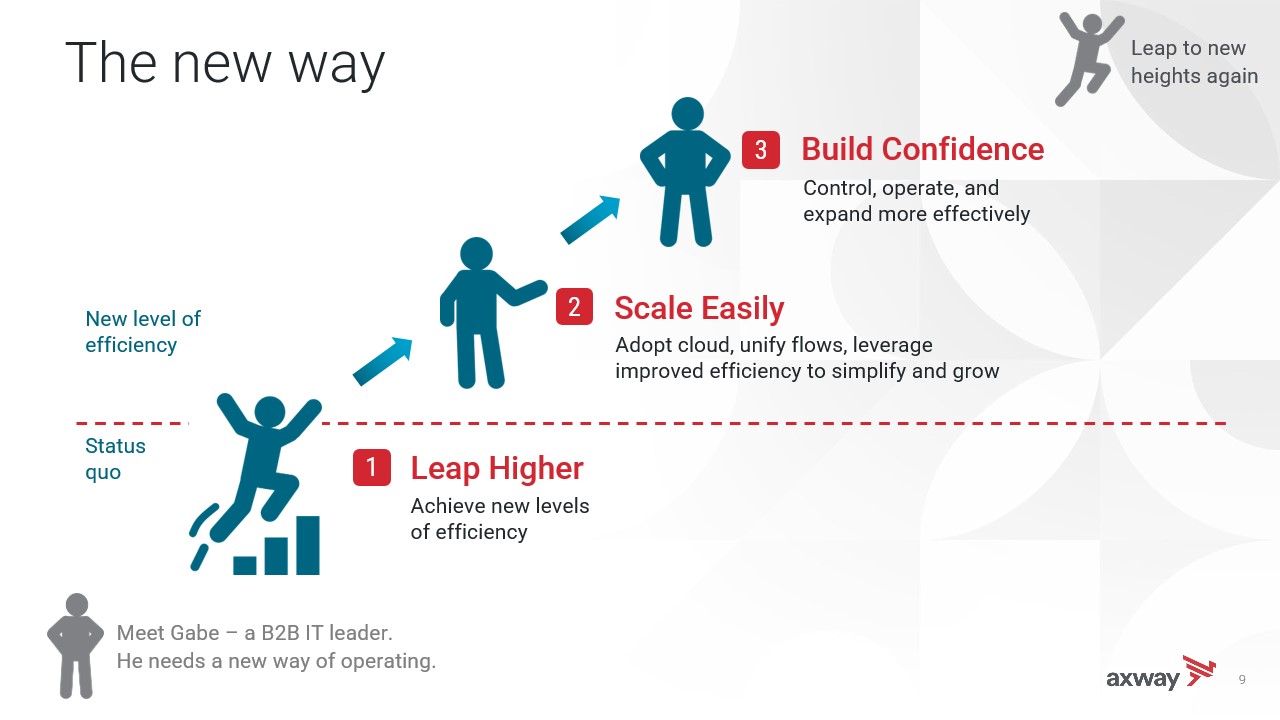
To reach this reality, companies need both a modern B2B integration solution and a new way of managing it. For Gabe, the transformation follows three clear steps:
- Leap Higher means breaking away from inefficient operational models by introducing automation, AI assistance, and modern integration capabilities that eliminate repetitive work.
- Scale Easily focuses on creating a unified environment that supports both EDI and API integration, allowing the ecosystem to grow without increasing complexity.
- Build Confidence ensures full operational visibility and proactive insights so potential issues can be detected early and resolved before they affect business operations.
Together, these steps transform B2B integration from fragile infrastructure into a reliable ecosystem that supports business growth.

Leap Higher
The first step is about working smarter and breaking away from the old way of doing things.
Today, many B2B teams spend too much time on manual work. Onboarding partners, configuring connections, and maintaining integrations often require multiple tools and repetitive tasks. By introducing automation and modern APIs, much of this work can run automatically and follow clear, repeatable processes.
AI also helps simplify some of the most complex tasks in B2B integration, such as mapping data between systems or handling transformation rules. Work that used to take hours, or even days, can now be done in minutes with far fewer errors.
See how you can accelerate with AI to Leap Higher
Prebuilt connectors also make a big difference. Instead of building integrations from scratch, teams can quickly connect to common business platforms like SAP, Amazon, Adobe, or Microsoft.
At the same time, Gabe’s team gains a better view of the business processes behind the transactions. Instead of tracking individual technical messages, they can see how orders, invoices, or supply chain transactions move across partners and systems. Even partner management becomes easier as tasks like certificate exchanges and renewals are automated.
The result is simple: less manual effort, faster integrations, and more time for the team to focus on supporting the business.
Scale Easily
Once operations become more efficient, the next challenge is growth.
A modern integration solution allows companies to manage both traditional EDI transactions and newer API integrations in one place. It can run on-premises, in the cloud, or in hybrid environments, giving organizations the flexibility to adapt as their business grows.
This also makes partner management far simpler. Whether a company works with 50 partners or 5,000, the process stays consistent. Standardized onboarding, built-in monitoring, and support for industry standards help keep operations predictable and manageable.
Instead of creating new complexity, growth becomes easier to support. The integration solution scales with the business rather than slowing it down.
Build Confidence
In B2B integration, confidence comes from knowing that everything is visible and under control. Modern solutions provide real-time insights into transactions, systems, and partner connections. With dashboards, alerts, and automated responses, teams can identify potential issues early and resolve them before they affect operations.
The B2B solution is also designed to scale reliably as transaction volumes grow or new partners join the ecosystem. Companies can choose how they run their integration environment, whether on-premises, in the cloud, or through managed services. A unified B2B workbench brings everything together in one place, allowing Gabe to monitor transactions, services, and systems across the entire environment without switching between tools. Instead of reacting to problems after they occur, his team can detect issues early and keep business processes running smoothly.
And for Gabe personally, this changes a lot. He no longer worries about unexpected alerts in the middle of the night or during the weekend. He can actually take a vacation and spend time with his family, knowing that the system is stable, visible, and under control.
See also: Make a smooth transition to a modern B2B integration platform
Making it real with Axway
Modern B2B integration requires both innovation and reliability.
Axway brings together API automation, AI capabilities, and strong EDI support in a single solution. This approach connects traditional B2B integration with modern API-driven architectures, allowing companies to modernize without disrupting existing operations.
Unlike vendors that focus on only one integration method, Axway supports the full B2B ecosystem, including EDI, APIs, file transfers, VANs, protocols, and industry standards.
The Axway B2B Integration solution is designed for enterprise scale, capable of processing billions of transactions with up to 99.99% SLA.
With the right solution in place, B2B integration no longer has to be a fragile infrastructure that teams struggle to maintain. Instead, it becomes a reliable foundation that supports business growth, partner collaboration, and digital transformation.
Take the next step toward smarter, more secure integration.