



Introducing AI into a B2B environment is primarily a security and governance challenge, not an execution challenge. Why?
AI systems rely on large volumes of data and automated decision-making, which can introduce risks around data quality, bias, compliance, and accountability. Without proper governance, organizations may struggle to ensure that AI outputs are reliable, auditable, and aligned with regulatory and business requirements.
The architectural goal is straightforward: AI must never directly execute critical business transactions or decisions without appropriate controls.
In the first part of this series, we highlighted a growing gap: while B2B integration platforms scale reliably as execution engines, the human effort required to understand, operate, and adapt them does not. AI offers a way to close that gap by improving how teams interpret data, handle requests, and respond to issues.
The next question is how to introduce that intelligence without disrupting the deterministic, auditable foundations these systems depend on. This requires more than adding AI on top: it calls for a controlled architectural approach that separates reasoning from execution and keeps governance firmly in place.
Now, let’s illustrate how this architectural approach can be applied in practice within an Axway B2B Integration environment using Amplify Fusion.
Axway B2B Integration remains the system of record and execution authority. All AI interaction is mediated by Axway Amplify Fusion acting as an AI gateway, ensuring consistent policy enforcement and observability.
Architectural roles and responsibilities
In this model, responsibilities are clearly defined:
- Axway B2B Integration handles deterministic, standard-based, auditable data exchange
- AI services provide language understanding, reasoning, and correlation
- Amplify Fusion acts as an AI gateway to connect both worlds through governed APIs
Why is an AI gateway needed? Because AI models don’t include basic security features, such as access control, identity management, and data restrictions – capabilities that are essential to any enterprise.
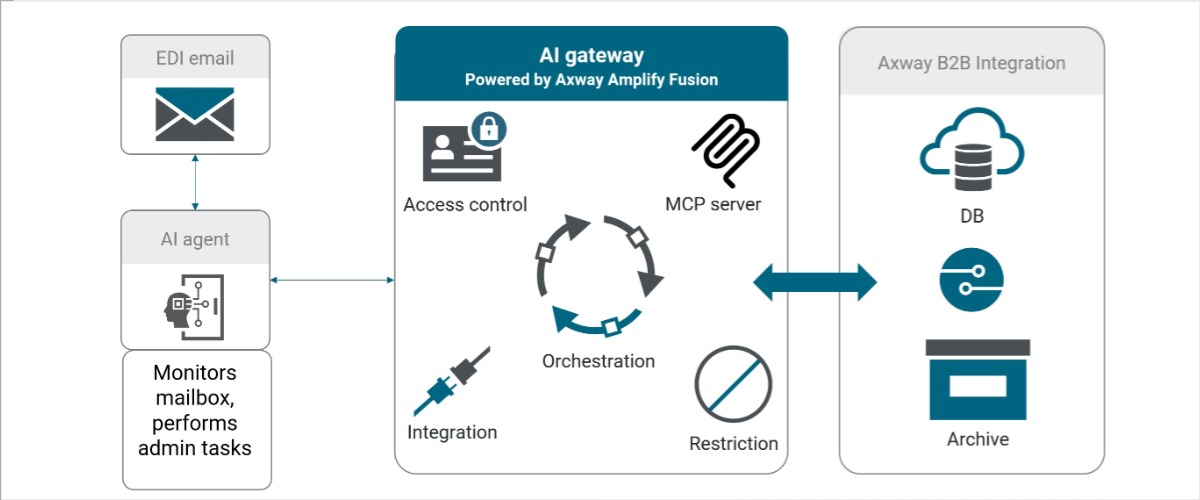

Think of the AI gateway as the control layer that manages how AI interacts with your B2B/EDI systems and data, in this case. It provides several key capabilities:
- Integration: Connects AI models to business applications and APIs, allowing them to access relevant data and trigger real actions
- Orchestration: Coordinates interactions across multiple systems (for example, combining data from different sources or executing multi-step workflows)
- Restriction: Controls what data is exposed to AI models by filtering, masking, or blocking sensitive information
- Access control: Ensures that only authorized users, applications, or agents can access specific AI capabilities, based on enterprise identity and security policies
- MCP server: An MCP (Model Context Protocol) server is a standardized bridge that connects AI models to external tools, databases, and data sources. Amplify AI Gateway can integrate with any existing MCP server, or create MCP servers itself if needed.
Dive deeper: Step-by-Step Guide to Setting up an MCP Server with Amplify Fusion
Together, these capabilities ensure that AI operates in a secure, governed, and fully connected way with your enterprise B2B/EDI environment.
Let’s look at a few real-life examples of AI use cases for B2B/EDI.
AI use case for B2B/EDI 1: AI chatbots to give business users easy access to B2B/EDI insights
In the first implementation pattern, AI can be used to make B2B/EDI insights accessible through natural language interfaces.
A business user interacts with a chatbot that communicates with an AI agent. The agent does not access Axway B2Bi directly; instead, all requests flow through Amplify Fusion, which applies identity and policy controls before retrieving relevant data.
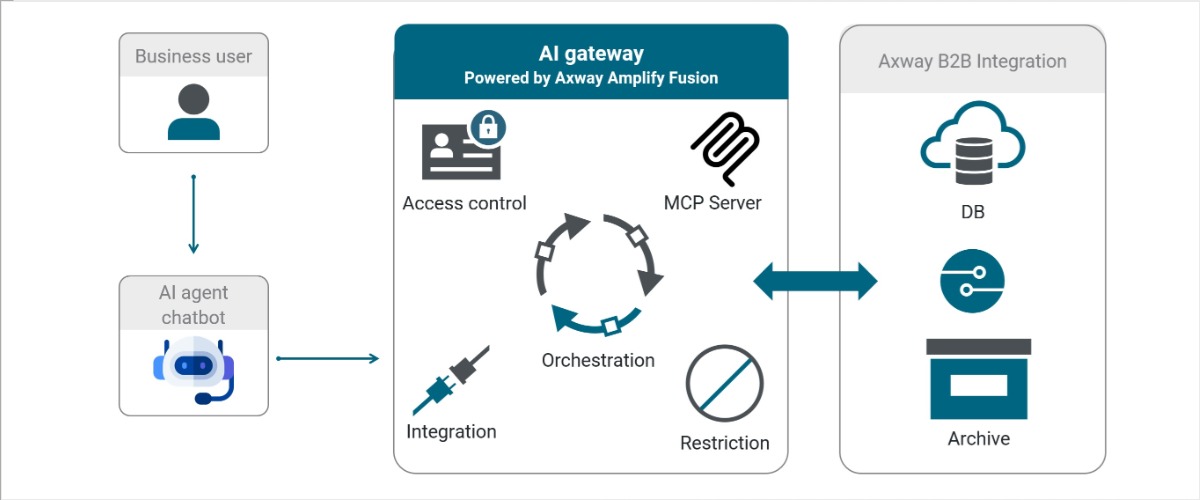
The AI agent can translate technical information into business-friendly explanations, such as message status, errors, or partner activity.
This creates a governed, conversational layer for accessing integration insights without exposing underlying complexity.
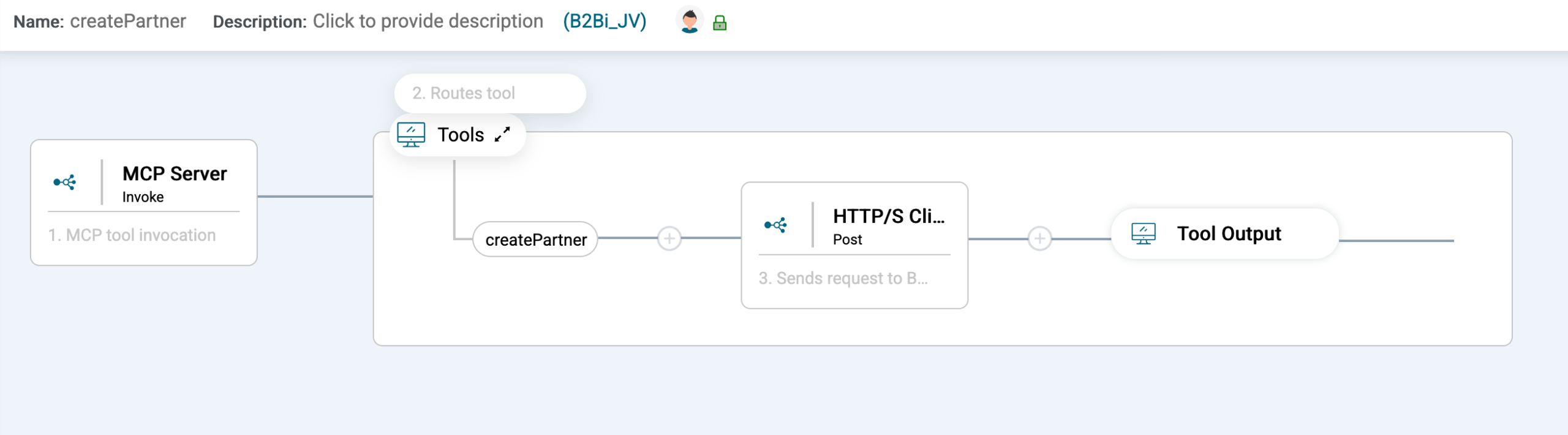

Screenshot of the configuration of Amplify Fusion showing how a chatbot via an MCP server can create a partner in Axway B2Bi
AI use case for B2B/EDI 2: Automate B2B/EDI administration and request handling
In the second pattern, AI supports operational workflows directly.
Here, an AI agent monitors incoming EDI emails and administrative signals. Inputs are ingested through the AI gateway and processed by the AI service, which classifies requests, correlates them with existing partner configuration, and prepares structured recommendations.
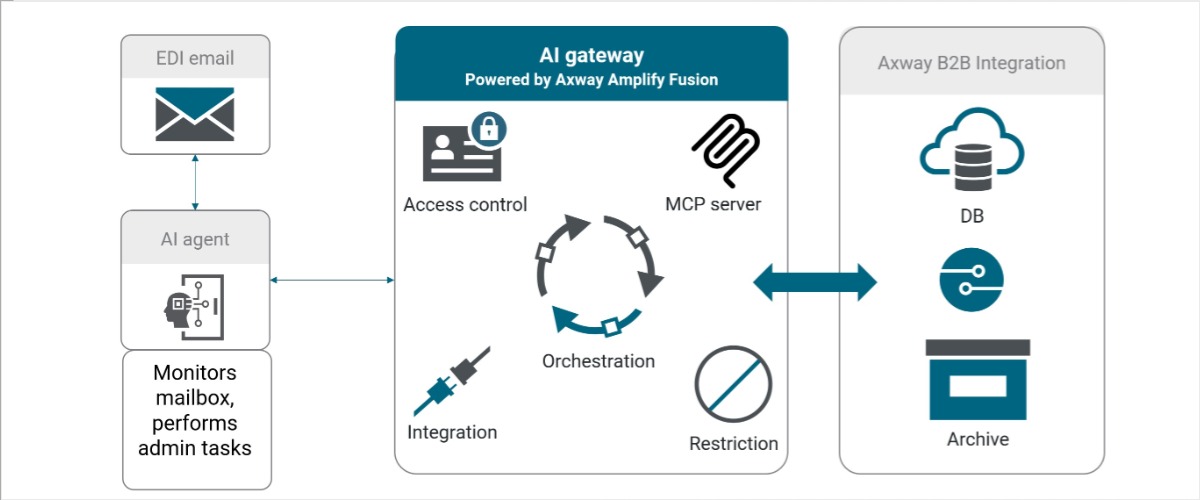
Over time, and with proper training and governance, AI can automate responses to well-defined, low-risk requests while keeping all actions traceable and auditable.
This allows administrators to focus on higher-value activities instead of repetitive tasks.
Where the first example focused on giving business users more autonomy using an AI chatbot, the second use case takes it a step further with an AI agent capable of taking well-defined but autonomous actions.
Policy-driven control as the foundation to bridging business value and architecture
Across both patterns, Amplify Fusion enforces a consistent security and governance layer. It defines what AI can access, manages data flows, and ensures that all interactions comply with enterprise policies. This allows probabilistic AI reasoning to coexist with deterministic B2B/EDI execution.
The initial challenge is operational: scaling human understanding around B2B/EDI systems. The solution is architectural: introducing AI through governed APIs and policies.
By placing AI behind governed APIs and policies with Amplify Fusion, organizations gain faster insight and improved responsiveness without compromising trust. Axway B2B Integration can continue to do what it does best, executing reliably, while Fusion ensures that intelligence is applied safely and transparently.
The result is a natural evolution from reliable execution to intelligent operations.
The capabilities we’ve demonstrated in the previous use cases are available today across Axway solutions:
- Axway B2Bi integrates with Amplify Fusion through native APIs, enabling AI-driven use cases with minimal setup
- Axway TSIM (primarily used today in the automotive industry) can also be connected to Amplify Fusion using the large set of technology connectors to support similar workflows.
Once connected, organizations can implement AI use cases that reduce operational costs and improve efficiency.