


B2B/EDI systems are among the most stable systems in enterprise IT. Axway B2B Integration has executed mission‑critical transactions for decades, surviving major architectural shifts such as adding API-led integration to EDI, from on‑premises to cloud, and nowadays, hybrid cloud, because its core promise remains unchanged: deterministic, auditable execution.
For most enterprises today, that execution layer is not the problem. Messages flow. Partners are connected. SLAs are largely met. The challenge lies in the day‑to‑day human effort required to understand, explain, and adapt what the solution is doing.
As partner ecosystems grow larger and more dynamic, this surrounding operational workload has become increasingly visible and harder to scale.
The B2B/EDI administrator’s point of view
From an administrator’s perspective, incident handling follows a familiar pattern. A customer reports an error related to a B2B/EDI document. The business forwards the complaint to the integration team, where an admin investigates the issue using monitoring tools and archives, identifies the cause, and communicates the resolution back.
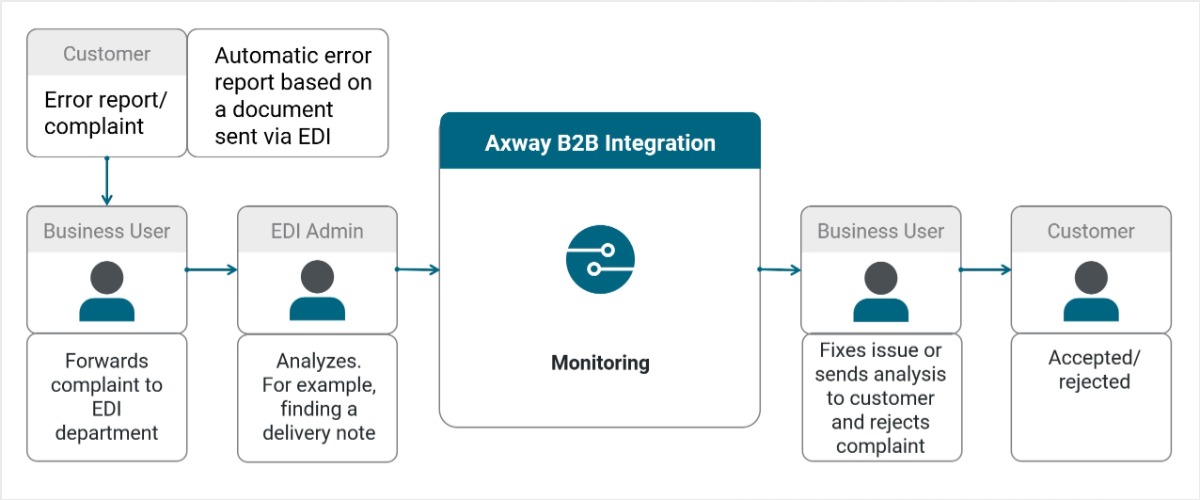
While structured on paper, this process is slow and cognitively demanding.
Error reports rarely arrive with message IDs or technical context. They reference business documents, timestamps, or vague delivery issues. Administrators must manually search message histories, correlate data points, and reconstruct events. Even though the system contains the required data, insight depends heavily on individual expertise.
As transaction volumes grow, this investigative effort does not scale, Resolution times increase, expert knowledge becomes a bottleneck, and responsiveness suffers.
AI adds value precisely at this point. It does not change how messages are processed. Instead, it accelerates correlation and explanation, helping users reach conclusions faster while preserving human oversight and accountability.
The EDI email inbox challenge
A second common scenario involves change requests rather than failures.
Partners send updates via email, such as new locations, identifier changes, expiring certificates, or format updates. These messages arrive unstructured in a shared EDI mailbox, mixed with alerts and general inquiries.
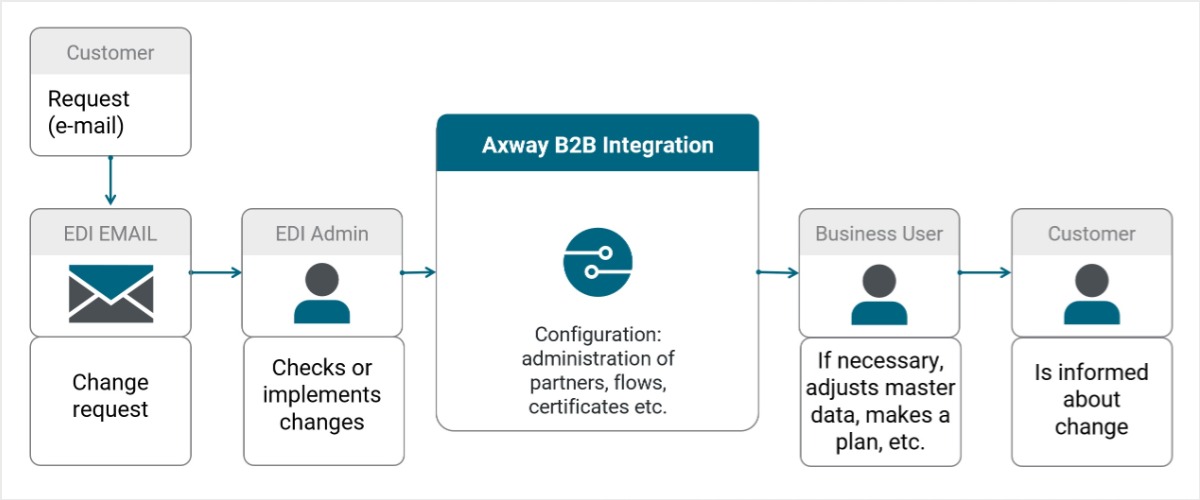
Each request must be interpreted, validated against existing partner configurations, applied, and confirmed. None of these steps are technically complex, but they are repetitive and time-sensitive. Over time, teams spend more effort processing incoming requests than improving integration quality.
Here again, AI does not remove governance or decision authority: it can improve intake and understanding. By extracting intent, matching requests to known partner data, and highlighting similar past changes, it reduces noise and allows administrators to focus on validation rather than triage.
From reliable execution to intelligent B2B/EDI operations
Both perspectives reveal the same structural limitation. B2B/EDI scales extremely well as an execution engine, but the human effort required to interpret and manage operations does not.
AI addresses this human scalability gap by improving understanding, responsiveness, and confidence in daily operations. It extends existing investments without disrupting trusted systems.
This naturally leads to the next question, which we will address more fully in a follow-up blog post: how can organizations introduce AI safely while maintaining full control and governance?
This is where the real shift happens: from recognizing the problem, to applying AI in a way that delivers measurable impact. In the meantime, you can see these principles in action in the demo below.
Ready to see how AI-powered B2B/EDI can simplify operations? Watch this demo to see how Axway B2Bi and Amplify Fusion work together.