


Most enterprises now operate under an AI mandate. Leadership teams expect AI to improve customer service, speed up operations, and inform decisions, and they expect measurable results soon. The question that follows is how to put AI into production without losing control of budget, security, and compliance.
Amplify Platform brings AI, APIs, and integration under one governance model.
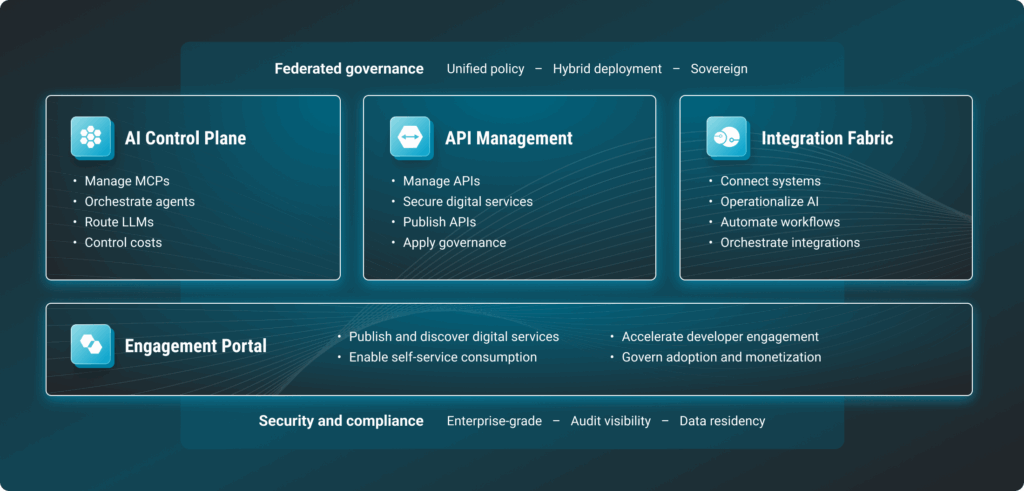
Integration Fabric connects the applications, data, events, and files a business runs on. AI Control Plane and API Management govern how AI agents, applications, developers and partners securely access those connected enterprise capabilities, with consistent policies across AI and API interactions. Engagement Portal delivers a governed engagement layer where developers, partners, business teams, and agents can discover, subscribe to, and reuse approved APIs, integrations, and AI services.
Amplify Platform moves AI from pilot to production without destabilizing existing systems. Organizations build on the systems they already run and trust. Current APIs and services become available to AI agents with the security and policies already applied to them. Cost stays visible as adoption grows. Amplify Platform tracks AI usage and spend by team, model, application, and agent, and lets organizations set limits where they need them, so leaders can plan budgets and attribute spending to the owners behind it.
That control is easier to keep when everything runs on one platform. Assembling separate point solutions for AI routing, API management, and integration often leaves teams building and maintaining the connections between the tools themselves. Amplify Platform runs these capabilities on a shared backbone, so the same integration logic can serve an application as an API or an AI agent as a tool. The platform stays vendor-neutral across the clouds, gateways, and models enterprises already use.
Sovereignty and compliance start with the architecture. Amplify Platform deploys on-premises, in hybrid environments, in sovereign clouds, or air-gapped, wherever business and regulatory requirements dictate. Sovereignty also applies to the data inside a workflow: Amplify Platform can redact or mask sensitive fields, such as an account number, before another system processes the data.
Amplify Platform meets the demands of regulated industries by building on Axway’s proven heritage in integration, governance, and security. For years, financial institutions, healthcare organizations, and government agencies have relied on Axway technology to connect critical systems, protect sensitive information, and govern digital interactions. Amplify Platform applies that same trusted foundation to AI, helping organizations adopt it with the control, resilience, and confidence their most critical operations require.
Four capabilities, one foundation
Amplify Platform combines four capabilities around a shared foundation of security, governance, and sovereignty. Integration Fabric connects and orchestrates enterprise systems and data. API Management governs and exposes APIs across environments, AI Control Plane governs models, agents, and MCP servers, and Engagement Portal makes approved services discoverable and reusable. Together, they give organizations one place to connect, govern, and expose what they build.
AI Control Plane
AI Control Plane turns AI experimentation into production-ready business outcomes by bringing AI agents, large language models (LLMs), and Model Context Protocol (MCP) servers under one control plane, including AI assets teams adopted without the need to involve IT. Policies govern every AI interaction by controlling access and protecting sensitive data. Teams can then monitor usage and spend by team, model, and use case, route each workload to the right model, and execute multi-agent workflows with consistent, auditable results. This governance can run on-premises, hybrid, or in a sovereign cloud.
Integration Fabric
Integration Fabric moves and orchestrates enterprise data across every system the business depends on. It links applications, APIs, data, events, and files across cloud and on-premises environments and automates the workflows that run across them. Teams design orchestrations visually, reuse governed integration flows, and connect AI agents to the enterprise systems they need to take action. Deployment governance spans development, test, and production from one console, with visibility into every step of every flow. Existing systems, including managed file transfer and B2B processes, stay in place as new digital and AI-enabled processes arrive.
API Management
API Management brings discovery, governance, security, and consumption of enterprise APIs into one platform, across every cloud, environment, and gateway vendor. Teams manage the full API lifecycle from design to production and apply consistent security and access policies along the way. Existing APIs can be published as AI-ready, MCP-enabled services that applications, partners, and agents can use, without rebuilding the capabilities behind them.
Engagement Portal
Engagement Portal makes what the other three capabilities produce easy to find and use. Publishing an API, agent, or integration does not guarantee that anyone will use it. Federated governance works with the gateways already in place, so teams can modernize the API estate without migrating it. Engagement Portal provides one governed catalog where developers, partners, business teams, and AI agents discover, subscribe to, and reuse approved services. Owners decide who can see and access each service, apply entitlements and usage limits, and track how internal and external audiences adopt each service. It also gives organizations a foundation for packaging and monetizing API and AI services.
Outcomes of a unified platform
Together, these capabilities turn a common technical foundation into business outcomes: governed AI adoption, lower compliance risk, modernization without disruption, and faster delivery through reuse.
Scale AI with confidence
AI initiatives reach production across teams and regions with governance, security, cost control, and compliance in place from the first deployment. Agents and models work with real customers, data, and transactions under the same oversight as every other enterprise service, so fewer promising pilots stall waiting for approval.
Spending stays under control and visible by team, model, and use case, so organizations can route each workload to the right model at the right price and adjust budgets to the value each initiative creates. A vendor-neutral architecture lets organizations adopt new models and providers as the market changes, on their own terms.
Reduce risk and simplify compliance
One operating model replaces separate governance silos for AI, APIs, and integrations. Policies apply consistently across every endpoint, interaction, and workflow, and every API and AI call leaves an audit trail. Audit readiness becomes part of daily operations: when a regulator or internal auditor asks, the evidence already exists in records the platform keeps. Data residency and sovereignty requirements hold across regions, clouds, and jurisdictions.
Modernize without disruption
Existing systems and investments keep their value as they take on new roles. Legacy applications connect to AI and modern workflows without rip-and-replace projects, and governance extends across the on-premises, multi-cloud, and edge environments already in place. New digital experiences and AI use cases build on the systems the business already depends on. Centralized monitoring improves operational efficiency and reliability, while a single platform leaves fewer tools to integrate, secure, and maintain.
Accelerate delivery and reuse
Teams find approved APIs and enterprise services through self-service and gain access through governed subscriptions. Developers create AI-ready and MCP-enabled services from capabilities that already exist, reuse flows and patterns across projects, and automate repetitive handoffs with visual design tools and prebuilt connectors. Services that are easy to find get reused, which raises adoption and turns digital assets into lasting business value. Over time, the same platform becomes the foundation for automation and agentic AI across the business.
Start where the value is
You can begin with the capability that addresses your most pressing need, whether that is governing AI, modernizing an API estate, automating workflows, or opening services to partners, and then expand the same platform over time.
Build on the systems you already trust to govern AI, modernize APIs, automate integration, and expand at your own pace without adding risk.
Explore Amplify Platform to see how one platform governs AI, APIs, and integration for regulated organizations.