


A new regulatory direction for corporate finance
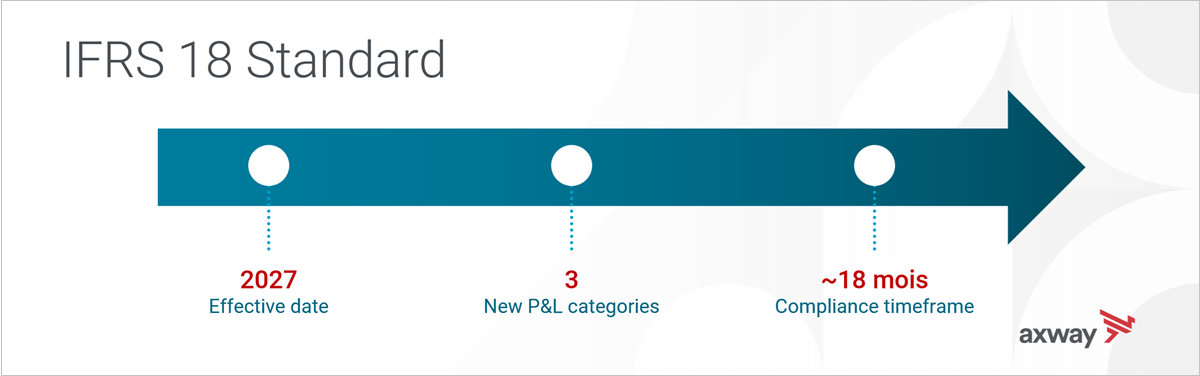
IFRS 18, which replaces IAS 1, introduces a fundamental restructuring of the income statement. It now requires a strict segmentation of revenues and expenses into three distinct categories: operating, investing, and financing. For finance departments, this change is not merely an accounting adjustment—it requires a redesign of data flows, greater granularity of information, and the ability to adapt systems quickly without disrupting existing operations.
Agility as a foundational solution
This is precisely where Axway Financial Accounting Hub stands out. Built around a flow-based integration architecture, the solution enables the adaptation of financial data pipelines without reprogramming source systems. With just a few configurations, it becomes possible to enrich existing flows with new qualification fields—analytical codes, flow types, IFRS attributes—without touching existing ERP or accounting systems.
Key capabilities for IFRS 18
- Dynamic data stream enrichment: Add IFRS metadata on the fly, without modifying source systems.
- Configurable granularity: Drill-down to the individual transaction level to meet disclosure requirements.
- Mapping of IFRS 18 categories: Configurable routing rules to assign each data stream to the correct P&L category.
- Reduced time-to-compliance: Deployment of new rules in weeks, not months, thanks to low-code configuration.
Data enrichment: change nothing, enrich everything
One of the practical challenges of IFRS 18 lies in classifying transactions. A single accounting entry can fall into different categories depending on the company’s context. Axway Financial Accounting Hub addresses this through its data transformation and enrichment capabilities: it is possible to inject supplementary data from third-party repositories—cost structures, profit centers, segment classifications—directly into the pipeline, without ad hoc development.
Granularity: the key to compliance and performance
IFRS 18 also strengthens reporting and reconciliation requirements. To meet these, it is no longer sufficient to work at the level of aggregated journal entries. Axway’s solution allows you to drill down to the individual transaction level, associate the necessary attributes, and deliver end-to-end traceable financial information. This granularity is not merely a response to auditors—it becomes a management tool for CFOs seeking to analyze performance by business unit, entity, or cash flow.
This is all the more strategic given that cloud-based financial ERPs, now widely adopted, impose significant constraints on the volume of data they can process and store at a granular level. Faced with millions of transactions that must be classified, aggregated, and reported in accordance with the new requirements of IFRS 18, these limitations become a real bottleneck.
Axway Financial Accounting Hub plays an essential complementary role here: designed to process very large volumes of data with high performance, it handles the granularity work upstream, thereby relieving the ERP of massive processing tasks while providing it with data that is already qualified, enriched, and compliant. This decoupled architecture allows companies to get the best of both worlds: the functional richness of their cloud ERP, and the high-volume processing power of a platform dedicated to financial data integration.
With IFRS 18, the question is no longer just whether your data is accurate, but whether your systems are agile enough to reclassify it tomorrow, without having to rebuild everything today.
In conclusion: anticipate rather than react
Companies that approach IFRS 18 as a simple accounting project risk underestimating the effort required to adapt their financial information systems. Those that rely on Axway Financial Accounting Hub have an advantage: a platform designed to evolve with regulations, capable of absorbing changes in standards without disrupting the existing architecture. In a constantly evolving regulatory environment, this agility is no longer a luxury—it is a prerequisite for sustainable performance.
Discover how Axway Financial Accounting Hub helps accelerate the digital transformation of the Finance Department by reducing the complexity of the financial information system.