



Regardless of a business’s products and services, B2B transactions are central to operations, whether communications with suppliers, customers, distributors, or even end consumers. These data transactions can come in the form of purchase orders, invoices, and notices of shipments, to name a few examples.
But these EDI transactions represent only a small part of a B2B integration platform.
What is a B2B integration platform?
A B2B integration platform is a software solution that automates the exchange of business documents, data, and transactions between a company and its trading partners. It connects systems that do not naturally communicate, so two or more businesses can work together more effectively, for example, shifting from a linear supply chain workflow to a modern partner ecosystem.
The platform acts as a bridge between disparate technologies. It provides a fast, reliable way for businesses to connect with customers, suppliers, trading partners, and service vendors. In short, business to business integration turns fragmented, point-to-point connections into one governed system of record for every partner exchange.

The market backdrop shows why this matters. The iPaaS market will grow from $10.5 billion in 2023 to $71.35 billion by 2030, a 32.3% compound annual growth rate, according to Grand View Research. The B2B integration software category is expanding in step, with the B2B middleware market projected to reach $11.6 billion by 2030 at a 7.2% CAGR, per Verified Market Research.
A modern vision for a B2B integration platform encompasses much more, and it is driven by three major demands in the marketplace today:
- All-in-one integration. Today’s enterprises struggle to unify traditional and modern integration flows. They increasingly want to streamline operations into a central, consistent user experience across B2B and EDI, API capabilities, integration platform as a service (iPaaS), compliance, monitoring, and e-invoicing.
- Supply chain resiliency. Distributed organizations seek out monitoring and predictability. They want to take quick action during supply chain disruptions, and their B2B integration platform must evolve to fit enterprise needs as the market shifts.
- Software that always works. Enterprises are replacing outdated, inefficient systems with a more modern, scalable, and secure environment. They want to deploy their B2B integration platform on-premises or in the cloud, using managed services and containerization.
It is a tall order, but it is the foundation we at Axway are building to serve B2B needs today and for the future. Here is a look at how a B2B integration platform works, how B2B integrations are evolving, and why B2B is so much more than just EDI flows.
See also: Axway named a Leader in the IDC MarketScape for Business-to-Business Middleware.
Why are B2B integration platforms a necessity?
A B2B integration platform is not an advantage; it is a need. Many businesses struggle to support a growing number of transactions and to navigate evolving security and policy regulations.
Integration debt is a big reason why. The average enterprise now runs 897 applications but has connected only 29% of them, according to the MuleSoft 2025 Connectivity Benchmark Report. Every unconnected system is a manual handoff, a delay, or a compliance risk waiting to surface.
The cost of getting this wrong is high. Direct procurement disruptions cost organizations an average of $16 million a year, according to Coupa’s State of Direct Spend 2026 report. Reliable B2B data integration is what keeps orders, shipments, and payments moving when conditions change.
Businesses need convergence with modern cloud-based enterprise resource planning (ERP) systems and partner ecosystems. A lack of agility in onboarding partners becomes a showstopper when they cannot answer new API-driven demands. Modern supply chains have always worked within larger systems of partners, but the EDI and proprietary integrations of the past have evolved into a streamlined combination of EDI and API-based integrations.
All this goes to say that B2B transactions are not simple relationships. With built-in variety in formats, protocols, and security requirements, there must be a way to bridge the gap so businesses can exchange data directly and stay agile for the future. Modern B2B integration services give businesses a leg up on getting new products and services to market faster, while stemming the cost of maintaining traditional EDI infrastructure.
How does a B2B integration platform work?
A B2B integration platform takes data from disparate sources and transforms it into a format that is acceptable to customers, suppliers, partners, and vendors. Classic B2B integration is based on Electronic Data Interchange (EDI), and the two terms have often been used interchangeably in the past.
With EDI, computer-to-computer communication replaced postal mail, fax, and email. But EDI has limits, which is why a modern B2B solution is also API-enabled to allow real-time access and data sharing directly into business applications. That lets you enforce traditional EDI communication and trade through modern API processes in the same B2B system integration.

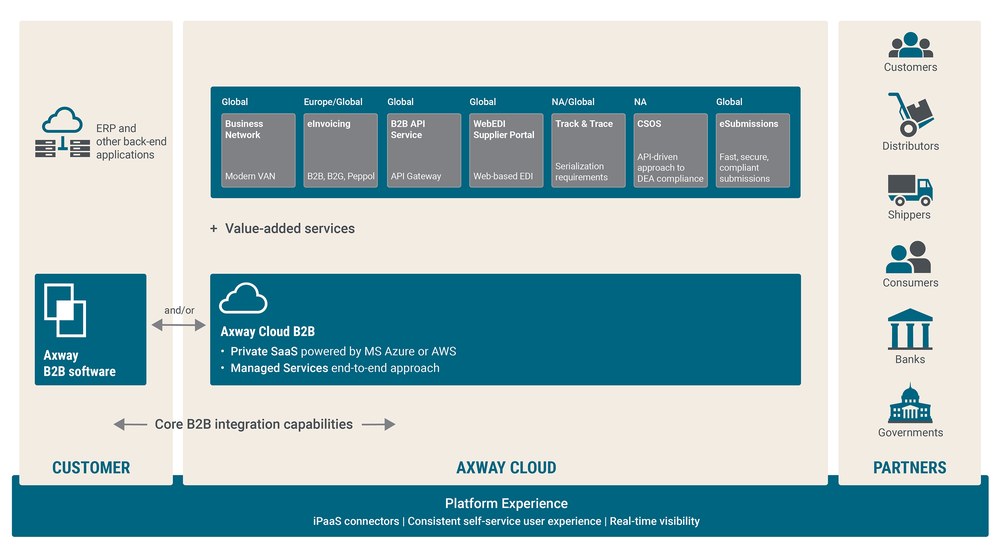
From a process standpoint, we can think of B2B data integration this way:
- Data is pulled from a business application through an API or another middleware technology and prepared for transmission to external parties.
- Data is automatically translated into an acceptable format, usually EDI, with the relationship between data fields mapped and visualized.
- Data is sent to external parties using the appropriate transport protocol, based on the sensitivity of the data, file size, and the speed at which the information needs to arrive.
- External parties receive and process the data through a target application that integrates it into core business processes.
- The platform layers on centralized visibility, constant monitoring to meet service-level agreements (SLAs), API integration capabilities, and value-added services like a value-added network (VAN), web-based EDI, Peppol, and e-invoicing.
Comparing EDI, API, and iPaaS methods of B2B integration
EDI, API, and iPaaS are the three main methods of B2B integration, and most enterprises use a blend of all three rather than choosing just one. EDI standardizes high-volume, structured documents between established partners. APIs add real-time, application-to-application connectivity. An iPaaS provides the connectors and orchestration that tie both approaches together.
EDI remains foundational, not legacy. The EDI software market will climb from $1.88 billion in 2023 to $5.30 billion by 2032, a 12.4% CAGR, according to Fortune Business Insights. The practical question is not EDI versus API, but how a single EDI integration platform can run both. The table below compares the three methods that a modern B2B EDI integration approach brings together.
| Attribute | EDI | API | iPaaS |
|---|---|---|---|
| Exchange style | Batch, structured documents | Real-time requests and responses | Event-driven orchestration |
| Best-fit use case | High-volume trading partners | Modern apps and cloud services | Connecting many systems at once |
| Standardization effort | High, based on EDIFACT and ANSI X12 | Moderate, based on REST and JSON | Low, based on prebuilt connectors |
| Technical skill required | EDI mapping specialists | Developers | Business and integration teams |
| Deployment | On-premises or cloud | Cloud-first | Cloud or hybrid |
The right B2B integration software does not force a choice. It lets EDI, API, and iPaaS run side by side, so you can keep proven partner connections while adding real-time integration where it creates value. Deployment stays flexible across on-premises, cloud, and hybrid models to match each partner and workload.
Key B2B protocols and standards like AS2, SFTP, EDIFACT, and X12
B2B protocols and standards define how trading partners format and transport data so that both sides interpret it the same way. A capable platform supports the full set rather than forcing partners onto one option. The core standards include:
- AS2 (Applicability Statement 2). A secure, receipt-confirmed transport widely used in retail and logistics.
- SFTP (SSH File Transfer Protocol). Encrypted file transfer for large or scheduled batches.
- EDIFACT and ANSI X12. The two dominant EDI document standards, used internationally and in North America.
- HL7 and FHIR. Healthcare data standards for clinical and administrative exchange.
Support for these standards is what separates a true B2B integration platform from a simple file-transfer tool. Broad protocol coverage means you can onboard a new trading partner on their terms, rather than asking them to change how they already work.
How B2B integration platforms handle security and compliance
B2B integration platforms protect data with encryption in transit and at rest, access controls, and continuous monitoring across every partner exchange. Because the data includes purchase orders, invoices, and personal information, security and compliance are core requirements, not add-ons. Strong platforms map to frameworks such as GDPR, HIPAA, and PCI DSS, and they keep an audit trail of every transaction.
Compliance is also a fast-moving growth driver. The global e-invoicing market will quadruple from $15.9 billion in 2024 to $68.7 billion by 2033, according to Research and Markets. That growth is mandate-driven. At least eight major e-invoicing mandates across Europe, the Middle East, and Asia-Pacific take effect within 18 months, according to Sovos. A platform that centralizes compliance turns each new mandate into a configuration change rather than a project.
How to choose a B2B integration platform
Choosing a B2B integration platform comes down to how well it fits your partners, your systems, and your compliance obligations. The strongest B2B integration tools score well across a consistent set of evaluation criteria:
- Protocol and standard coverage. Support for AS2, SFTP, EDIFACT, ANSI X12, and API-based exchange, so you can meet partners where they are.
- Partner onboarding speed. Self-service enrollment and reusable templates that cut onboarding from weeks to days.
- Deployment flexibility. On-premises, cloud, and hybrid options, including managed cloud services.
- Security and compliance. Encryption, access controls, and support for GDPR, HIPAA, and e-invoicing mandates.
- Visibility and monitoring. Real-time transaction tracking and SLA alerting across every flow.
- Scalability and total cost. Headroom to grow transaction volumes without a matching rise in maintenance effort.
Weighing B2B integration services against these criteria keeps the decision grounded in outcomes rather than feature lists. The best fit is the platform that shortens onboarding, reduces manual work, and adapts as your partner ecosystem grows.
What are some examples of B2B integration in practice?
The easiest way to understand the value of a B2B integration platform is to consider real-world examples of how it fits into business operations.
Say you are an automobile manufacturer that deals with multiple suppliers, from tire manufacturers to aluminum material suppliers. Files like purchase orders and receipts are sent between the businesses on a routine basis. With B2B gateways, this information is exchanged in a standard format, so it is easily interpreted by various parties regardless of the systems they use.
Consider a medical product manufacturer with retail providers across the country. Just one retailer can have up to 1,500 locations, which translates into thousands of hours of onboarding work. With a B2B integration platform, the manufacturer can create automated onboarding patterns that save hours of manual work.
For example, Cencora operates one of the largest healthcare supply chains in the U.S. Each day, the company exchanges more than 800,000 EDI messages with more than 23,000 trading partners, using Axway B2Bi to deliver a scalable, highly available digital front door for all business units.
B2B integration is entering a new era shaped by what we call symbiotic partner ecosystems.
Stass Pertsovskiy, Director of B2B Product Marketing at Axway, in Logistics partner ecosystem management
Where is today’s B2B integration ecosystem headed?
B2B integration started as a way to electronically exchange data between businesses. That remains essential, but the scope has evolved. Alongside saving time and cost, modern B2B integration platforms strive to create a collaborative ecosystem with partners that drives modern supply chain practices.
Self-service onboarding saves significant time for internal teams while giving partners the control they want. That flexibility should extend to security and visibility, with an end-to-end view of business transactions so you can monitor issues and improve response times.
Finally, as artificial intelligence comes of age, it will continue to drive transformation in the ways businesses exchange data, from verticalization to AI-driven mapping, analytics, and proactive error detection. Axway explores this shift in the power of AI in B2B integration.
Choose Axway as your B2B integration platform
Available as software or managed cloud services, Axway B2B Integration modernizes your infrastructure to meet today’s needs, with the flexibility to scale for future demands. Axway supports all integration patterns, including EDI, modern APIs, API-driven VAN, iPaaS connectors, and ERP, with security across every exchange.
B2B is core to Axway. We have continuously improved data communication and transformation capabilities over the last 20 years, and Axway B2Bi is a high-performing, reliable, scalable solution with a friendly user experience. With broad deployment, management, and cloud options, Axway B2Bi supports partner and community management through self-service features while offering real-time EDI visibility into all applications.
Are you prepared for where B2B is headed in the next 10 years? Download this white paper to learn more.
Frequently Asked Questions
What are B2B integration services?
B2B integration services are managed and platform-based offerings that automate the exchange of documents and data between a company and its trading partners. They cover EDI, API, and value-added network connectivity, along with partner onboarding, monitoring, and compliance.
What is B2B EDI integration?
B2B EDI integration is the exchange of standardized business documents, such as purchase orders and invoices, between partners using Electronic Data Interchange formats like EDIFACT and ANSI X12. A modern platform pairs it with APIs for real-time exchange.
What is B2B integration software?
B2B integration software is the application layer that translates, routes, secures, and monitors data moving between trading partners. It replaces brittle point-to-point connections with one governed system for every partner exchange.
What is B2B data integration?
B2B data integration is the process of mapping and transforming data between two organizations so their systems can interpret it the same way. It handles differences in formats, protocols, and standards across partners.
What is business to business integration?
Business to business integration is the automation of transactions and communications between separate companies, most often across supply chains. It connects ERP, EDI, and API systems so partners can trade without manual handoffs.
What are B2B integration tools?
B2B integration tools are the connectors, mapping utilities, protocol adapters, and monitoring dashboards that a platform provides to build and run partner integrations. Broad tool coverage shortens onboarding and reduces maintenance.
What is B2B system integration?
B2B system integration connects the internal systems of two or more businesses, such as ERP, warehouse management, and order systems, so data flows automatically between them. It supports both EDI and API-based exchange.
What is an EDI integration platform?
An EDI integration platform is a system that automates the creation, translation, transport, and tracking of EDI documents with trading partners. Modern versions also add API connectivity, so EDI and real-time integration run together.